
Whether you’re just starting your investment journey or working toward investing for retirement, the world of investing can feel overwhelming …
Which investments make the most sense? What won’t put my hard-earned money at risk? How do I actually purchase them?
Fortunately, there’s one powerful investment vehicle that addresses all these concerns while simplifying the entire process – investing in an index fund.
Why Index Funds Make Sense for Most Investors
Index funds represent a remarkably straightforward approach for everyday investors to capture broad market returns without the complexity of researching individual companies. This investment strategy has gained such widespread acceptance that legendary investor Warren Buffett actively endorses it.
This sounds promising, but what exactly defines an index fund? Why have they earned such strong recommendations from financial experts?

Understanding Index Funds
An index fund is essentially a curated collection of investments that investors use to gauge daily market performance. These collections are frequently called benchmarks in financial circles.
Charles Dow created the first prominent index, the Dow Jones, in 1896. Instead of attempting to average every available company’s stock price, Dow adopted a more practical approach by focusing on just the top 12 companies. His reasoning was that tracking these leading firms would provide a reliable “litmus test” for overall market performance each day.
This concept gained traction over time, leading more investors to discuss market performance through “indices” rather than individual stock movements.
Today’s marketplace offers diverse index funds covering virtually every segment of stocks and bonds. For large-cap stock exposure, the S&P 500 index stands as the most recognized benchmark. This index tracks the 500 largest and most successful U.S. companies.
The Key Advantages of Index Fund Investing
For decades, investors have dedicated significant time and energy to selecting winning companies for their portfolios. However, this approach presents considerable challenges! Success demands extensive research and risk tolerance that most people lack.
Jack Bogle (Vanguard’s founder) revolutionized investing in the 1970s with an elegant insight: Market indices already identify the strongest companies. By investing in the entire index, you automatically capture the market’s average return.
Simply put:
Long-term wealth building favors index fund investing over individual stock picking.
This principle has been validated repeatedly through expert analysis, academic research, and market history.
Remarkably, even professional fund managers dedicated to “selecting superior investments” consistently fail to outperform index funds. CNBC reports that 85 percent of large-cap funds underperformed over the past decade, while nearly 92 percent have trailed the S&P 500 index over 15 years.
The takeaway is unmistakable. Average investors can skip the complexity of “fund selection” and achieve solid returns by directing their money toward index funds.

Your Guide to Buying Index Funds
How does someone actually purchase an index fund?
Nearly every major financial services company now provides index fund options. We’ll use Fidelity Investments to demonstrate the complete purchasing process.
Locate Your Ideal Index Fund
Start by visiting Fidelity’s website directly. Navigate to the top menu, hover over “Investment Products,” then select “Mutual Funds.”

Look for “Explore Fund Offering” in the page’s center section and click it.

Find “Explore the full spectrum of available Fidelity Funds” and select the “Index” tab. Scroll down to view Fidelity’s complete index fund lineup.

Remember, index funds don’t exclusively track large-cap stocks. For a straightforward S&P 500 index fund purchase, locate “Fidelity 500 Index Fund (FXAIX)” under “Domestic Stock.” Click the FXAIX ticker symbol to access the fund’s detailed homepage.
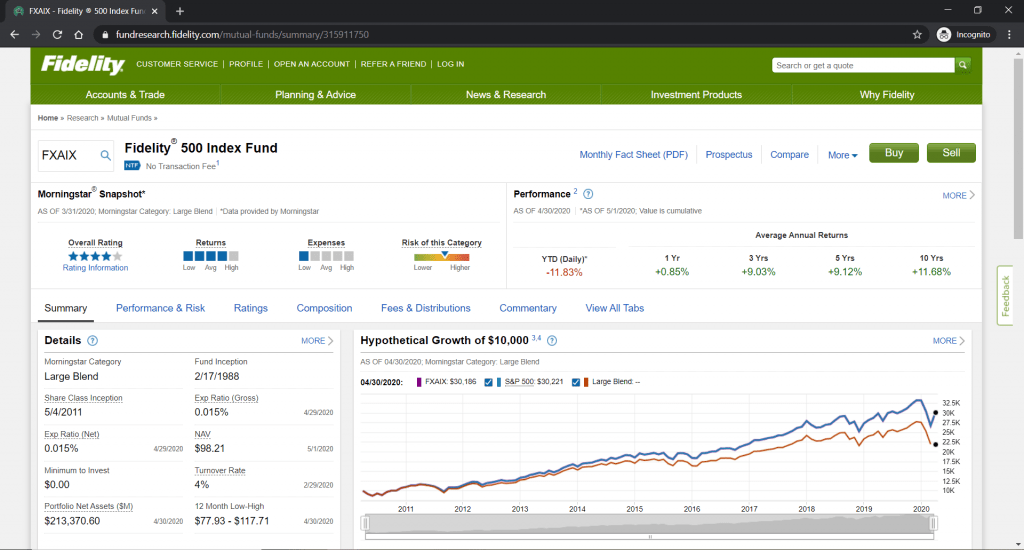
This page provides comprehensive fund information, including:
Snapshot – Current fund ratings from organizations like Morningstar.
Performance – Fund returns for this year, previous years, and decade-long periods.
Details – Critical information including security types, operational history, and fund structure.
Pay special attention to these two crucial details:
- Minimum Investment – Unlike many funds requiring $1,000 or more upfront, this fund has no minimum investment requirement.
- Expense Ratio – Currently just 0.015%. You’ll pay only $1.50 annually for every $10,000 invested. That’s exceptionally affordable!
Additional Resources – The page’s middle section features tabs (Performance & Risk, Ratings, Composition, etc.) offering deeper fund insights. Explore each section to fully understand your potential investment.
Complete Your Index Fund Purchase
When you’re satisfied and ready to invest, click the green “Buy” button in the upper right corner. New users will need to create a profile and establish a brokerage account (your funding source for making investments).
Important consideration:
Consider opening an IRA during your purchase process if you don’t already have one.
Based on your eligibility for accounts like a Roth IRA, you might reduce your taxable income and lower your annual tax burden. Additionally, your investments will grow and compound tax-free over time, eliminating annual taxes on gains and dividends.
For existing Fidelity customers, simply confirm your purchase details … and congratulations, you’re now an index fund investor!


