
Saving money alone won’t make you wealthy—it’ll actually cost you. With inflation eating away at your purchasing power and interest rates barely reaching 2% on even the best savings accounts, your cash loses value over time.
That’s precisely why investing becomes essential. However, investing presents its own challenges. Stock markets swing wildly, while navigating mutual funds can feel overwhelming for newcomers.
Many investors turn to bonds for their stability and consistent returns. That’s where Worthy Bonds enters the picture.
This platform delivers 5% annual returns on bond investments with remarkable simplicity. Getting started costs just $10, making it accessible to virtually anyone.
But is Worthy Bonds legitimate? Should you trust them with your hard-earned money? This comprehensive Worthy Bonds review covers everything you need to know.
What Is Worthy Bonds?
Worthy Financial launched Worthy Bonds in 2016 from its Florida headquarters. Founder Sally Outlaw brings impressive credentials as a registered investment advisor and former CEO of Peer Backers, a startup fundraising platform.
Following its launch, the company quickly raised $600,000 in seed funding and secured $1,000,000 in total investments. Today, over 10,000 investors actively use the platform.
The platform offers 36-month bond coupons in $10 increments. These bonds fund small businesses and nonprofits seeking capital, who then repay the loans with interest that flows back to bondholders. This peer-to-peer lending model sets Worthy Bonds apart as an explicitly anti-Wall Street alternative.
Don’t expect Worthy Bonds to replace your entire investment strategy—it works best as a portfolio complement since diversification remains crucial. Additionally, these accounts lack FDIC insurance protection.
Every investment carries risk, of course. Worthy Bonds mitigates this through asset-backed securities, reducing default concerns significantly. For investors seeking alternatives to traditional savings accounts, Worthy Bonds presents a compelling option.
How To Use Worthy Bonds
Creating your Worthy Bonds account is straightforward, though you’ll need to provide personal information including your Social Security Number, address, and birthdate. You’ll also connect a financial account—all standard requirements for bond investing.
The platform protects your data with 256-bit encryption, ensuring maximum security for your sensitive information.

Next, choose your account type. Most users select individual accounts funded through personal bank accounts.
The platform’s simplicity shines here. Unlike feature-heavy apps like Acorns, Worthy Bonds focuses on essentials. You can establish recurring investments and access basic tools, but the interface stays clean and uncluttered.
This streamlined approach benefits users perfectly. Worthy Bonds prioritizes simplicity above all else. When you need liquidity, withdrawals happen instantly without any penalties or fees.
The 5% Interest Rate
This attractive rate immediately catches investors’ attention. Earning 5% significantly outpaces typical savings accounts offering 1-2%, virtually guaranteeing your money outpaces inflation.
However, some risk exists. Beyond the lack of FDIC insurance, Worthy Bonds hasn’t navigated a complete recession cycle yet. While neither factor guarantees investment losses during economic downturns, these considerations deserve careful thought.
Worthy Bonds Investment Limits
The platform recognizes two investor categories: accredited and unaccredited. Accredited investors who meet specific income requirements can invest up to $50,000 in bonds. Non-accredited investors face limits of 10% of their net worth or annual income.
Accredited status requires earning $200,000+ annually for the past two years. Everyone else falls into the non-accredited category.
Risk Mitigation
The absence of FDIC insurance often alarms potential investors. However, bonds cannot receive FDIC protection since Worthy Bonds operates as an investment platform, not a bank.
Despite this limitation, Worthy Bonds implements meaningful risk reduction strategies. All bonds receive backing through borrower inventories. When defaults occur, these assets get liquidated to recover investor funds.
Additionally, Worthy Bonds maintains SEC registration for regulatory compliance.
Worthy Bonds Loose Change Investing
Bond purchases happen seamlessly through their website or mobile app. The user experience remains intuitive throughout.
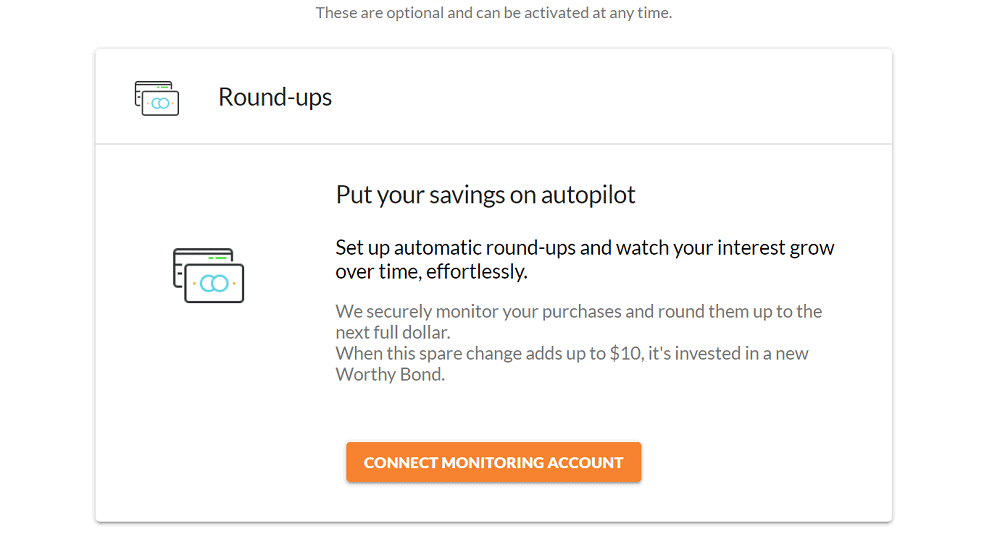
The platform’s standout feature lets you invest spare change from card purchases. When you buy coffee for $3.75, Worthy Bonds can invest the remaining $0.25. After accumulating $10, the system automatically purchases another bond.
Automatic recurring investments further streamline the process, creating a hands-off approach to building your bond portfolio.

Who Should Use Worthy Bonds?
Worthy Bonds appeals to investors across wealth levels, whether you’re managing $1,000 or $1,000,000. Anyone seeking solid returns with manageable risk should explore this platform.
The service particularly suits these investor types:
- Those seeking better returns than standard savings accounts
- Investors preferring hands-off investment approaches
- People requiring liquidity flexibility
- Those comfortable with relatively short 36-month terms
- Investors looking to diversify their portfolios
Is Worthy Bonds Worth It?
Worthy Bonds charges zero monthly fees. You pay only for bond purchases themselves, with entry possible at just $10.00.

This pricing structure beats competing investment platforms significantly. Acorns, a leading roundup investment service, charges $1-3 monthly. While seemingly modest, these fees can represent substantial percentages for investors with smaller account balances.
Given the minimal investment requirement, starting small makes perfect sense. Consider investing $10-100 initially to test the waters. You can always increase your investment later if the platform meets your expectations.
Worthy Bonds Alternatives
Your ideal alternative depends on your specific priorities. Security-focused investors might choose high-yield savings accounts, while others prefer robo-advisors or peer-to-peer lending networks.
High Yield Savings Account
Let’s be honest—”high yield” feels misleading. Currently, the best available APY hovers around 0.91%. Invest 00, and you’ll earn roughly $1009 by year’s end.

The reality gets more complex with account fees, minimum balances, and potential opening bonuses affecting your actual returns.
You’ll barely outpace what you initially deposited, but these accounts provide safety and beat letting money stagnate in checking accounts where inflation automatically erodes your purchasing power.
Acorns

Acorns pioneered roundup investing and recurring contributions for beginning investors. Like Worthy Bonds, it offers anytime withdrawals without penalties.
The key difference lies in investment strategy. Acorns uses algorithmic robo-advisor technology to invest across diversified stock and bond portfolios based on your risk tolerance (conservative through aggressive).
Acorns provides broader financial tools and features like Found Money, which maximizes platform ROI through cashback partnerships.
Monthly fees start at $1, but become increasingly negligible as your asset balance grows over time.
Ultimately, Acorns and Worthy Bonds complement each other beautifully. Their low barriers to entry make using both platforms feasible for enhanced portfolio diversification.
Worthy Bonds: The Final Verdict
Worthy Bonds excels at providing direct bond investing without fees while delivering impressive returns. For investors seeking relatively low-risk investments with short fixed terms and penalty-free early withdrawals, Worthy Bonds deserves serious consideration.
Pros
- High interest rate compared to savings account
- Very low investment to get started
- Easy to use
- Recurring investing and roundups turn investing on autopilot
- Risk is fairly
- Cannot see your investment portfolio
- Bonds support small businesses
- Anybody can invest
- Includes tax-advantaged account options
- Good way to diversify your portfolio
- Very liquid, you can withdraw money anytime
Cons
- Not FDIC insured so there is some risk
- Limit on investments
- Not recession tested (yet)
- Doesn’t sell corporate or government issued bonds
- Not the most competitive investment
- Would be nice if they had some other financial management tools packaged in


